Sunday, June 30, 2013

Roasted potatoes and radishes


Roasted radishes, a very light meal with a lovely colour

Ironically it looks like summer has deserted Switzerland too this year after a semi-shadowed equally non-existent spring. The temperatures during the day are pushing through to 16 degrees Celsius (61F) with the effort of an untrained runner crossing the marathon finish line. People were wearing coats and scarves and one lady even had a coat with fur lining on yesterday. At least she was keeping warm and looked cozy like someone coming in from a chilly night and sitting down on a chair where a cat had been curling up for an hour.

Massive summer BBQ activity is delayed too. The national sausage called Cervelat hit the news again this week. This sausage is a Swiss phenomenon like "Wiener Schnitzel" or "Apfelstrudel" in Austria, "Kartoffelsalat" in Germany or "must leib" (dark rye bread) in Estonia. If something happens to such national food, it is bound to make the news. This time half a page of the morning newspaper was dedicated to the analysis that the Cervelat prices were going up by 10% at all major retailers. The positive side is that due to the delayed grilling season the wallets of the Swiss Cervelat afficionados will retain their weight for a bit longer.
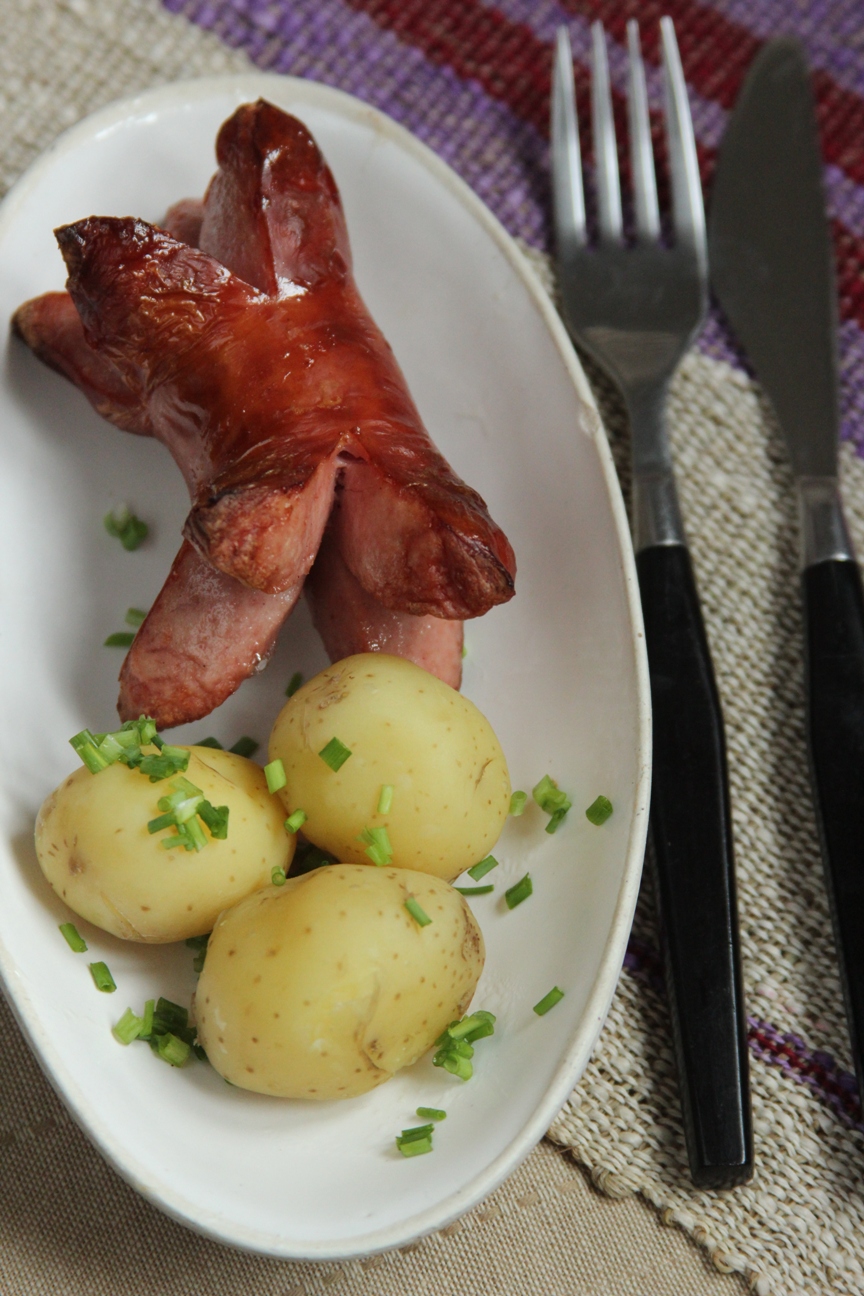
Swiss national sausage, makes the news at least every year

In this cold mood, me wearing a wollen jumper, it seemed rather approapriate to heat up the oven to 200C (400F) and stuff it with some potatoes and fresh radishes.

Instructions:
Potatoes
1. Wash the potatoes and radishes thoroughly.
2. Cut the potatoes into quarters, place them in a baking dish.
3. Sprinkle with sea salt and add a couple of sprigs of fresh rosemary from the herb garden and a generous amount of peeled garlic cloves.
4. Drizzle with oil.
5. Cover with a piece of aluminium foil and cook in the oven for about 40 minutes. Then remove the foil and bake further 15 minutes to give the potatoes a nice crust.

Season the potatoes with herbs, garlic and sea salt
Roasted potato wedges with rosemary and garlic

Radishes
1. Halve the radishes and spread them in a baking dish.
2. Drizzle with olive oil, season with salt and pepper.
3. Cook for ca. 20 min in the oven.
Radishes need a lot less time in the oven than the potatoes.


Fresh radishes ready to go in the oven
Freshly roasted radishes have a silky taste


I made a cheese-yoghurt topping from grated old Gouda, a couple of tablespoons of Greek yoghurt and a tablespoon of mayonese and had the potatoes as a main course. These can be also served as a side dish to a more meaty main course or to a grilled Cervelat. 

Keeping warm and happy.

Sunday, June 23, 2013

Cold cucumber and strawberry soup

A refreshing soup in the strawberry season

I had an eye-opening moment this May when I realised that the lunch take-away places had stopped serving soup. I checked out all my regular soup places and sighed my way out shoulders sinking lower at each door. It seemed like all of them had agreed to stop serving soup as of first of May. It slowly sank in it that this must be the normal practice. Soup is served in winter and replaced by green and mixed salads in summer. OK, makes sense.

The thing that didn´t quite make sense was the fact that this year the whole May was an extension of winter. The maximum day temperatures swinging between 8-13 degrees Celsius. Far from the weather that calls for a cooling salad. Moreover, the prepared towers of salad boxes did not seem to be selling as fast as oven warm bread at all. But rules are rules or traditions are traditions. No soup after 1st May regardless of the outside temperatures.

The other thing that didn´t quite make sense for me, an eager soup fan, was a selfish question of what if I wish to eat soup all year round. The answer to that would be to make your own soup or go to a sit-down restaurant as they still serve soups all year round.

I can hear the nutritionists in the West, East and ayurvedic rush to explain that the hot weather requires cold or moderate temperature foods. Fair enough. In summer, there is a place for cold soups.

Gazpacho in Spain, šaltibarščiai Lithuania, cold beetroot and buttermilk soup in Estonia, a chilled cucumber soup or a highlight last summer a cold lemon confit soup at Le Pré Verre in Paris,  all a blessing in the heat. These are just a few that immediately flash through my mind when I think of cold soups.

Ingredients for the cucumber-strawberry soup

Cold cucumber and strawberry soup
Strawberries go well with black pepper and peppermint and let combine in a savoury dish equally gracefully.

Ingredients for 2 portions or 6 small appetisers
half a long salad cucumber, peeled and cut into small pieces
250g fresh strawberries, green tops removed, cut into small pieces
1-2dl tomato passata or any tomato sauce a nature
1 small clove of fresh garlic, chrushed
a small bunch of fresh thyme, finely chopped
a small bunch of fresh Moroccan peppermint leaves, finely chopped
juice of half a lemon
salt
black pepper
1 tsp sugar
extra virgin olive oil

Mix the cucumbers and strawberries with herbs and seasonings
Mix the cucumber and strawberry pieces with the tomato sauce, garlic, thyme, peppermint,  salt, black pepper, sugar and leave to marinate for 30 minutes.

Purée in a blender or with a hand mixer until smooth.
Taste for salt, sweetness and spice and ajust if necessary.
Keep refrigerated until serving. Serve with some extra virgin olive oil sprinkled on top.

The soup has low calories, however does fill the stomach quite well.


Cold soup of cucumber and strawberry served as a small appetizer


Sunday, June 9, 2013

Cake Auction: Passion Fruit / Maracuja Cake

The past two weeks have excited the enthusiastic patissiers at the office as much as the eager colleagues who have been generously bidding or buying lottery tickets in the hope to win a piece of self made cake.

We saw masterpieces of decoration ("An ambulance cake"!) and "Divine drops of paradise" that took the happy winners, drooling in the corners of their mouth, to heaven even if just for a brief moment.

Our Brazilian-Mexican-Estonian team Baked produced a maracuja cake. This involved creating a recipe based on some special Brazilian ingredients. The cake was layered and wrapped in two different fresh cream mixes and pushed over the finish with labor intensive (whew!) chocolate deco. Our cake proudly raised over 360 Swiss francs or 380 dollars.

Passion Fruit / Maracuja cake from the team Baked

The money that all these cakes raised is supporting a local school for children with special needs -Heilpedagogischer Tagesschule Biel.

The teachers, the headmaster and the children make the school a most kind and genuine place. Their school, as they say themselves, is a place for encounter, learning and celebration. They celebrate happy and sad moments every morning with a ceremony and they take time to say hello to everyone before the work in the classrooms starts. At this bi-lingual school the children learn new things, develop various skills and celebrate life. Respect.

This Vol.2 of our cake is a little thank you to the generous bidders. Their money is well spent.

Celebrate life. Learn. ....and eat cake!

A Thank You eddition of the Maracuja Cake for generous donators

Sunday, May 5, 2013

Watercress soup

Watercress or Bachkresse in Swizerland

It is rare to see watercress on sale in Switzerland. It does not exist in the supermarkets, it is yet to be seen as the Swiss supermarkets are adapting to a wider range of products in the last years.

It is rather rare at the farmers´market too. Almost non-existent. When I saw the mushroom-man sell wild garlic and Bachkresse or watercresse the decision was made in my head in a few seconds. I made a mental note to strike through some other ingredients oin my shopping list replacing one planned meal with this new surprise.

Watercress soup with sourdough fougasse with olives
 
Water cress soup
Ingredients:
1 tbsp oil (e.g rape seed oil)
1 shallott, chopped
3 medium potatoes, cut into cubes
1 dash of white wine (optional)
0.7 l stock  
100g watercresse
2-3 tbsp fresh cream
salt
pepper

Heat the oil, cook the onions in it until glassy, then add the potatoes and cook for a couple of minutes. Splash in the wine and let it evaporate. Add the stock and cook on medium heat until the potatoes are soft. Add the watercress and cook for a couple of minutes until they soften.

Remove from heat and puree. Add the cream, bring back to boil. Season and serve.

Saturday, April 27, 2013

Kohlrabi and wild garlic soup

For health conscious Fabi

After the extended winter this year the choice of the fresh vegetables at the farmers´ market is starting to multiply week by week and the opportunities to shake up another snazzy soup are equally expanding.


Aromatic Wild Garlic

The season for wild garlic in the nothern hemisphere is mainly in April and May. It finds its rightful place in a wild garlic risotto, can be folded into bread dough, mixed into a pesto or used raw to burst its garlicky taste. It has a smoother garlic taste than the conventional garlic cloves.

I thank my colleague Eli and her generous Mom and her garden where the wild garlic grows like weed.

I picked up one of the kohlrabis from the pile of these freshly harvested vegetables and assessed the baby smooth skin and the juicy crunch inside. The good ones have a kind of sweaky sound. Perfect! Can´t wait to be in the kitchen and 30 minutes later here comes lunch... Can´t be any fresher.

Fresh Kohlrabi (Swiss Rübkohl, Estonian Nuikapsas)

Kohlrabi and wild garlic soup

Ingredients for 2:
1 tbsp vegetable oil (eg. rape seed)
1-2 onion, chopped
1 Kohlrabi, cut into cubes
0.5 dl white wine or white sherry (optional)
0.7 l vegetable or chicken stock
2 tbsp fresh cream
salt
pepper
6-8 leaves of wild garlic, cut into fine stripes

Main ingredients for the kohlrabi & wild garlic soup

Heat the oil in a pan and cook the onions until for about 5 minutes until translucent.
Add the kohlrabi and cook for a few more minutes. Add the wine and let it sizzle away, then add the stock. Cook until kohlrabi is soft, about 10 minutes.

Take the soup off the heat and pureé until smooth. Mix in the cream and bring to boil. Season with salt and pepper.

Serve with freshly cut wild garlic leaves.


Kohlrabi and wild garlic soup

Sunday, April 21, 2013

Home Made Wild Garlic Bread

Wild garlic loaf (German Bärlauch Brot)

I suppose wild garlic is a little bit of Love or Hate thing. Less so if eaten raw, as in a raw state it resembles conventional garlic quite a lot. It reveals its special taste and aroma in some cooked dishes. Bread is one of such ways that when detected can be a real pleasure for the gourmet palate or may put off an eater not familiar with this herb.

In any case, for any curious mind, to find out if you have a love or hate relationship with wild garlic bread I invite you to try it out in your own kitchen.

Wild garlic at the market in April

Wild Garlic Bread
Ingredients for a small loaf
ca 15 g of fresh yeast
2.5 cups of dark wheat flour (I used the Swiss Ruchmehl)
0.5 tsp salt
2 tbs olive oil + a bit more for kneading
a small bunch (6-8 leaves) of wild garlic, finely chopped
1-1.5 dl water

Dissolve the yeast in a bowl in 0.5 dl water. Add the flour, oil, salt and the wild garlic. Add the water and mix the components together by hand. If the dough does not stick together add a little bit more water but not too much.

Put about 1 tbsp olive oil on the working surface where you knead the dough. Take the dough out of the bowl and start kneading it, stretching and folding it together for about 10 minutes until gluten builds and the dough becoms elastic and does not stick to the hands any more.

Drizzle some olive oil (again no more than 1 tablespoon) on the bottom and sides of the bowl and place the dough ball back into the bowl. Cover tightly with cling film and cover with kitchen towles. Leave to raise (prove) in a warm place for an hour or until the dough has doubled its size.

Preheat the oven to 220 Celsius.

When the dough has risen, take it out of the bowl onto the working surface and stretch and press out the air. Then fold the dough into a loaf and place it into the baking form fitted with the baking paper. If you wish, make a cut lengthwise.

Place a tray with water into the oven to create steam to support the making of the crust. Now the loaf goes into the hot oven for 20 minutes. After 20 minutes turn down the heat to 200C and continue baking for another 20 minutes.

Knock on the crust, but take care not to burn yourself. Hearing a hollow sound is a good sign. Place the loaf on a cooling rack and get the fresh bread afficionados ready around the table to taste your work. Serve with butter.

Serve the fresh wild garlic bread with butter


More recipes with wild garlic:
Red snapper on wild garlic risotto

Sunday, March 31, 2013

Estonian Sweet Curd Pudding that melts in your mouth (Estonian: Suus sulav kohupiimavorm)

Estonian sweet curd pudding melts in your mouth

A long Easter weekend in Switzerland with two public holidays, enough time to colour eggs, eat fish and meat, make some curd desserts. The farmers´ market on Saturday morning was full of beautifully decorated eggs. The lady at my usual egg stand almost charged me double for my plain white eggs, thinking I had filled my carton with their painted masterpieces. The most common Estonian way is to dye Easter eggs with onion skins. You can find other Estonian Easter recipes on NAMI-NAMI food blog, written by another Estonian food fan.

Sweet curd desserts are quite popular during Easter in some countries. In Switzerland probably less so, but further north definitely. This year, Easter is so early that winter is still in its full arctic reign across most of Europe. I want to share a simple secret recipe for the irresistible indulgence for two in front of the fireplace or under the duvet during the snowy and rainy days. If you are generous, the recipe will stretch itself to be divided into three portions but four would be pushing it. For a party of four double the quantity.

These pudding bites disappeared in less than 5 minutes

Sweet Curd Pudding 
Ingredients:

750g low fat curds (German: Magerquark)
180g  sour cream (12-15% fat)
3 eggs
4 tbsp fine wheat semolina
1 tbsp flour
0.5 teaspoon baking powder
6 tbsp sugar
vanilla extract or contents of half the pod

Preheat the oven to 175° Celcius (350F).

Mix everything in a big bowl. Select either a round, square or a loaf shape baking tin. Prepare the baking form covering the bottom and sides with baking paper.

The shape of the baking form is totally up to you

Bake for 45-60 minutes or even longer until the pudding has hardened. The cooking time depends on the thickness, the thicker the dough in the form the longer the baking time.

Serve hot or cold, for an extra portion of sweetness dust with sugar (and cinnamon) or serve with some fresh raspberries or black currants.

Serve most of the curd pudding warm or cold, but definitely try a hot slice straight from the oven

More curd dessert ideas:
Sweet curd balls (Estonian: kohupiimapontshikud)

Sunday, March 24, 2013

Cinnamon and apple rolls

Cinnamon and apple rolls

Cinnamon rolls have a certain cult status in the North of Europe. Whether it comes from the childhood experience or reading Astrid Lindgren´s books or just from having a whole raft of baked sweet cinnamon and yeast dough combinations as part of the everyday life, they are definitely on the list of "Happy foods". Perhaps like the famous Argentinian "alfajores" are for the Argentinians and wider South Americans. A similar feel good smily feeling arises with the well known "pasteis de nata" from Portugal.

Hereby I allow myself a brief digression from food to language. Namely, there is a word "küpsetis" in Estonian that denotes anything baked. I could use it as "kaneeliküpsetis" meaning anything baked with cinnamon without specifying the form of it. I struggle to find an appropriate quivalent in English. It is fine to be specific with "cinnamon rolls, cinnamon loaf, cinnamon cake, cinnamon-apple rolls, cinnamon biscuits, cinnamon sticks, etc, etc. The trouble arises when I am short of a word thinking I would like something baked with cinnamon when I haven´t quite yet decided in what form that baked someting with cinnamon should look like today. This is four words in the attempt of just wanting to say "kaneeliküpsetis". I suppose the dilemma is another example of the Estonian language being rather economising and not wasteful of words and therefore not as lavish in synonyms.

Cinnamon and apple rolls
Ingredients (makes 8-10)
25g fresh yeast
2 tsp sugar
a pinch of salt
1 dl warm (not hot) milk
1dl warm water
1 dl rape seed oil
200g + 80g flour (plain or whole wheat/German "halbweiss")
1 egg, beaten

Filling:
20g soft butter
2 sweeter apples, seeds removed, grated
cinnamon
10 tbsp sugar

Mix yeast, sugar and salt until the yeast becomes liquid. Add warm milk, warm water, cooking oil and fold in the flour for a few minutes until a smooth dough is formed. Leave to raise under two tea towels in a warm place without draft. When the dough has raised for an hour fold in the rest of the flour and leave to raise again under the towel for 45 minutes.

Yeast dough

Preheat the oven to 200° Celcius.
 
Place the dough on a floured surface and spread it thin either by hand or using a rolling pin.The dough should be about 5-7mm thin. Not too thin as you want to spread the soft butter on the dough now without breaking it. Then sprinkle sugar and a generous amount of cinnamon on the dough. spread the grated apples on the dough and from one seide lengthwise start to roll the dough into a long roll.Cut the long roll into 3-4cm thick slices and place them on a baking tray or into small baking forms. I buttered the forms slightly. leave to raise for 10 minutes.
Brush the rolls with egg.


Bake in the oven for about 30 minutes until golden on the top.

Generous amount of cinnamon is key in these apple rolls


Enjoy warm or cold.

More from the Cinnamon Bakery:
Red Beetroot Cinnamon Rolls
Cinnamon Loaf

Sunday, March 17, 2013

Carrot and fresh goat´s cheese pie

Carrot and goat´s cheese pie

I took a trip to the farmers´market to get my next dosage of carrots.  The farmer with the Egyptian pyramid hat has such sweet carrtos, even though they are stored over winter they are addictively fresh and crunchy even at the end of March. The decision of a carrot pie with goat´s cheese was taken when the young cheese maker handed me the piece of fresh goat´s cheese. I had been eyeing that cheese for a few times thinking what to pair it with. Some stronger and saltier cheese and herbs de Provance type of flavours would do the trick...with some darker flour.

Ingredients for the pie filling

Ingredients:
15g fresh yeast
1 tsp sugar
a pinch of salt
1 dl warm milk
1 dl warm water
0.5 dl rape seed oil
150g dark wheat flour ("Ruchmehl" in Switzerland)
80g whole wheat flour 

Filling:
400g boiled carrot, crushed
200g fresh goat´s cheese
50g hard cheese like Grana Padano or Parmesan, grated
black pepper from the mill
thyme leaves

0.5 egg, beaten

Mix the yeast with sugar and salt until liquid, then add the water, milk, oil and flours and combine. Cover the dough with kitchen towels and leave the dough to raise for about one hour.

Boil the carrots in salt water, cool down, remove the peel and crush with a fork. I like a rustic slightly coarser bite. For a smooth filling crushing the carrots in a food processor will do the job.

Heat the oven to 200 degrees Celsius
Cut the goat´s cheese into small pieces, and together with the grated hard cheese, pepper and thyme add to the carrots. Taste for salt.

The filling spread on the dough

Spread the dough on a flour dusted table or counter and place the carrot mix on the dough. Roll lengthwise together. Cover the baking tray with baking paper and place the pie on the tray. Brush the pie with the egg mixture and bake in the oven for 30 min.

Carrot pie with thyme, and two cheeses

Serve the pie warm or cold with tea or milk

For more try also  Carrot pie with chunky parmesan

Sunday, February 10, 2013

Roasted Carrot and Chickpea Hummus

Roasted carrot and chickpea hummus
 I happened to see an interview with a popular Estonian writer and a respected thought leader Mihkel Mutt. Shooting many thought pearls from his sharp cannon he was talking about why we should read and re-read the classics.
If we only read whatever new comes along there is a risk that people will adopt bad as acceptable, acceptable as mediocre, mediocre as good and good as genius. The classics help us to re-calibrate the important criteria in life.

I was thinking about this all day and while the tought was inspiring to always aspire perfection it rang a bell in a culinary sense as well. The classic recipes are classic, because they are good and are treasured by millions of mouths because the classics make them happy. The classic cooking methods are classic again because they have worked for long and will continue to attract new generations.

Adopting eating habits that lead to diabetes in early ages as acceptable, aisles of packaged ready-made food as satisfactory, fast food as good nutrition and a plate of take away "pasta bolognese" as genius is crying out for an occasional visit to a real quality restaurant or Mom´s kitchen or foodie friends to re-calibrate the main criteria.

Roasted Carrot and Chickpea Hummus
Ingredients:
200g carrots, cut into 1-2cm pieces
2-3 tbsp cooking oil
salt
cumin powder

1 can chickpeas
2 tbsp tahini paste
1 clove garlic, crushed
2 tbsp olive oil
juice of half a lemon
3 tbsp cold water
1/2 tsp salt
pepper
1/2 tsp cumin powder
1/2 tsp coriander powder

Add more colour to pale hummus with roasted carrots

Heat the oven to 200 C, place the carrots into a baking tray, sprinkle with oil, a pinch of salt and a pinch of cumin powder and roast the carrots until soft, ca. 30-40 minutes. Cool them down.

In a food processor mix the roasted carrots. Add chickpeas, tahini paste, garlic, olive oil, lemon juice, water, salt, pepper, cumin and coriander powders. Mix until smooth and well combined.

Drizzle olive oil and sprinkle some more cumin powder and serve with crisps, tortilla chips or thin roasted bread slices.

A more northern taste of classic hummus, with roasted carrots

Sunday, January 27, 2013

Carrot and Rutabaga (swede) soup with lime

Carrot and yellow rutabaga (swede) soup with lime

I am a big fan of winter vegetables. Carrots, beetroots, celeriac, rutabaga (aka swede in Europe), potatoes, salcify, ... In European climate they store well either in the cold stores or in some countries even in the ground. For example in the UK where the climate is milder carrots can be stored in the ground over winter. In Estonia it would not be the case as the temperatures fall and stay well under zero (Celcius) and the fields are covered in snow for weeks if not months in good winters.

These days the farmers´market on the main square in the Swiss capital has been pushed to one side making room for a temporary skating rink. In very cold days some of the farmers don´t come out and in their usual places under the arches of the market streets would be a few yawning gaps. Still there is plenty of choice to fill up each basket and trolley bag with winter vegetables, a wide range of apples and pears, fresh eggs, cheeses, butter as well as fish and meat.

Behind one of the vegetable counters is a couple, perhaps in their fifties. The man, always in winter wearing a blue knitted hat that stands up like an Egiptian pyramid on his head, his ears reaching above the rim of the hat keeping the pyramid steady on both sides. He is very energetic and talks funny in a loud voice, often measuring the vegies by eye or a feel of their weight by hand. My pound of potatoes turned out to be just over 600g when I weighed them at home. The funniest part is getting the change back, some of it is "for the taxes", the coins often "for a cup of coffee" or some other treat. :-) I bet his wife is having a laugh at home like their customers are entertained on Saturday mornings.

Carrot and yellow rutabaga (swede) soup with lime
Ingredients (for 4 as a starter or 2 as a supper)

2-3 tbsp vegetable oil
1 medium shallot onion (ca 50g), sliced
3-4 garlic cloves
1 rutabaga (ca 200g), peeled and cut into cubes
250g carrots, cut into cubes 
800ml vegetable stock
1 stalk of lemongrass
2 kaffir lime leaves
1 tbsp desiccated coconut
salt, pepper
1 tbsp cream or coconut milk  
1 tbsp lime juice
1 green onion stalk, finely chopped 

Carrot, swede, onion, ginger, garlic, kaffir lime leaves, lemon grass

Heat the oil in a pan and cook the onions until glassy, add the garlic and cut vegetables. Stir and cook for about 5 minutes before adding the stock, lemongrass, kaffir lime leaves, desiccated coconut. Bring to boil and simmer for 15-20 minutes until carrots and rutabaga are soft. They both have similar cooking time.

Purée with a mixer, add the cream and season to taste with salt, pepper and lime juice.
Serve hot with green onions.

Swede and carrot soup seasoned with lime and lemongrass

You may also like these soups:
White swede (rutabaga) and celeraic soup (with fish)
Spicy sweet potato soup
Leek and potato soup with blue Stilton
Carrot soup with courgette (zucchini) and fresh salmon 

Sunday, January 13, 2013

Winter: White swede (rutabaga) and celeriac soup with or without fish

White swede (rutabaga) and celeriac soup

Almost all food magazines I leafed through today at the kiosk dedicate a section on soups as the perfect winter food. Rightly so, however I doubt if anyone would really sit outside, read a book and enjoy a bowl of soup in winter in the northern hemisphere anywhere above the 47° N latitude like a beautiful photo was suggesting in one of these magazines.

I was waiting to board a flight around 4pm in early January in Helsinki and was looking out of the airport window. This was the time just before the evening darkness fell. My view through the frame was the dark blue sky, bordering black, a tick darker wall of forest on the horizon at the edge of the tarmac, a lonely yellow lamp not reaching past the gate, no other building in sight. The pressing "kaamos" (polar night, also referred to as winter tiredness) was only interrupted by an occasional plane rolling in to its gate somewhere. It was dark.

In the north where the darkness rules many months paradoxically the start of winter on the 21st December is actually the first step to the light again. That step is noticable already in the first days of January when the day is just a few minutes longer and life takes on a more optimistic note even if just psychologically. Most of the cold is still ahead....

Time for a bowl of soup with two winter vegetables: white fleshed swede and celeriac.
Swede is known as rutabaga in North America. If you are sensitive to the slightly bitter taste of swede then in the combination with the sweet note of celeriac that bitterness is not felt at all.

White swede (rutabaga) and celeriac soup
Ingredients (2 portions)
1 celeriac
1 white swede
bay leaf
5-6 grains of allspice
2 leaves of leek
800 ml vegetable stock
2 tablespoons sour cream or crème fraîche
a small bunch of cress
salt and black or cayenne pepper

400g bream, cod or salmon, cut into 2cm cubes
2 tablespoons (rape seed) oil

White fleshed swede (rutabaga), celeriac, leek, bay leaf, allspice

Cut the celeriac and swede into small cubes and place in a pan together with a bay leaf, grains of allspice, leek and add the stock. Cook for about 10 minutes until the vegetables are soft.
Remove from heat and take out the bay leaf, allspice and leek. Using a blender or hand mixer purée into a soup. Season with salt and pepper and mix in the cream.

Briefly fry the fish

Heat the oil in a pan and fry the fish for 3-4 minutes turning sides.

Serve the soup with chopped cress and portion the fish directly at serving.
Also tastes great without the fish as a vegetarian option.

Cream of swede and celeriac with fish

Tuesday, December 25, 2012

Christmas cookies and Estonian piparkoogid


Marzipan cookies
 
In Switzerland and Germany the typical Christmas cookies are Vanille Kipferln (vanilla half moons), Zimt Sterne (cinnamon and almond stars), and many others often made with ground almonds, hazelnuts, walnuts.

This year I set out to extend the line of the cookies and pair the dark Piparkoogid with a contrasting marzipan and orange cookies.

Marzipan - orange cookies from Germany

Piparkoogid are traditional Christmas cookies in Estonia and Scandinavia. Christmas and New Year without piparkoogid just doesn´t feel right. Piparkoogid are made with lots of different spices, cinnamon, ginger, clove, cardamom, nutmeg, orange peel, black pepper. The most important part of the preparation of the dough is burning the sugar. It gets very very hot, must not be over burnt, but under burning leaves the cookies too pale. The burnt sugar gives the piparkoogid the brown colour. It is good to let the dough rest for at least 24 hours and it can stay in the fridge even for a month. It almost has to given the volumes that all get baked during the last weeks of December.

Estonian Piparkoogid - Christmas ginger cookies

My Mom bakes lots of them for my Dad and for all the friends of the family. I usually make half of her  portion and that amounts to roughly 1000 pieces. So you can imagine a big basket of piparkoogid at my parents that gets filled and emptied and filled again. I must add that we love the very small ones and because they are small the hand just doesn´t stop going back to the bowl for more...and more...

Making Estonian Piparkoogid from dough
Small Piparkoogid are the best
I hope Santa will be in my town on the 24th, any day really would be good. He is a busy man visiting all of your towns too and hopefully with some foodie presents in his sack.

Merry Christmas to everyone!

Sunday, December 9, 2012

Pear and Persimmon Polenta Bread

Polenta Bread with Persimmon Kaki and Pear

I am lucky to have a lot of very international colleagues. My colleague who comes from Florida, a highly skilled cook herself, has awakened my palet to corn bread. This introduction happened last year during our cookbook project. To be perfectly honest I had mixed feelings with the first bite of her corn bread. On one hand I was so happy to have found something that is so simple, so tasty with qualities that would make a dish a family favourite instantly and on the other hand I couldn´t believe that it had taken me decades to get acquainted with this US staple. Of course I know why it is. Corn is not a staple in Estonia or in northern Europe for that matter. Polenta is more a southern European ingredient. It is grown in Italy or in Ticino in my current country Switzerland. In any case corn bread has found a place on my favourites list.


Today I am sharing a fruity version of the corn bread. Both pears and persimmons are quite sweet fruits and therefore don´t require too much added sugar. The changes to my friend´s recipe include adding the sour cream and the fruit, changing the quantities of flour, sugar and bicarbonate baking soda.

Pear and Persimmon Polenta Bread
Ingredients:

200g fine polenta
100g flour
1tsp bicarbonate soda
300dl butter milk
100g sour cream
2 large eggs
4 tbsp sugar
0.5 tsp salt
50g butter, melted
1 medium large pear (250g), grated
1 persimmon kaki, grated

Set the oven on 200 degrees Celsius.
In a large bowl whisk together butter milk, sour cream, eggs, sugar, salt and bicarbonate soda.
Add grated pear and persimmon, melted butter as well as the flour and polenta.
Combine everything into a smooth batter.

Fit baking paper into a tray (eg. 20 x 30cm) and trasfer the batter into the baking tray.

Bake for 30 minutes until golden brown.

Serve warm or cold. Dust powdered sugar on top if you prefer.

Fruity Corn Bread with Pear and Persimmon