Sunday, May 6, 2012

Changes in the food world across two centuries and "kilupirukad" (small salty oily fish pastries)

There are fundamental changes happening in every area of life at a fast pace. The changes around the food and eating burst emotions left and right like a metronome. We find things that never existed before, that are genius and on the other hand see things that make perfect sense disappear or nonsense flourish. Here is a short list of observations that I have lived through or experience at this very moment.

End of the last century: Estonia
Few cookbooks
Every household had at least one handwritten recipe notebook
Simple food… still my favourite
Eaters were much closer to food production (neighbours helping neighbours at potato harvest, own food grown on allotments)
Less packaged food, often food was weighed in the shop according to your order, often packed in paper, very little plastic packaging
People carried a shopping bag, plastic bags were expensive and even not available
Less allergies
Less food regulatory laws (I used to walk by a bread factory that had its windows open to the street, the smell coming out was heaven. Loaves of bread used to be sold unpacked in shops. Nobody died of dysentery coming from the bread they had bought that wasn’t individually packed)
Less E-ingredients, the big money wasn´t in the food research
Shorter life expectancy
A lot of food was very local
Recycling of milk bottles, cream and mayo jars, other bottles (there wasn’t much other packaging to recycle)
Deficit of exotic fruit, coffee, other ingredients (eg to cook a Thai curry at home in 1990 was unthinkable)
Home made jams was a common way of preserving
Estonians loved “Tallinna kilu”, small oily fish spiced and preserved in cans (see photo)
Tallinna kilud have stood the test of time

21st century: Estonia, Switzerland, Europe
More packaged foods
Fashionable to take a plastic bag each time – fortunately this trend is reversing
Less knowledge about where food is grown or how –  fewer children have seen, let alone touched, an animal whose produce they eat, TV programs showing children guessing how peas, cabbage, brussel sprouts etc grow… a tragic comedy
Better agriculture
New varieties of produce are higher yielding and stay fresh longer (sometimes at the expense of smell or taste)
Hydroponicly grown strawberries flown across Europe in March
More allergies
People live longer (combined with progress in medicine)
Long aisles of ready made meals
Food wasting increases massively
Smart mobile phones – internet saves the work of writing down the ingredient list
Food magazines have a booklet with shopping list for ingredients
Thousands of food blogs
El Bulli, Heston Blumenthal, molecular cuisine
Nordic chefs winning the French culinary competitions
Frozen food, big freezers at home allow storing fresh food, great to have fresh berries from your own garden in winter
Celebrities´cookbooks
Celebrity chefs acting on TV People talk about food miles, local, seasonal food
Estonians love “Tallinna kilu”, small oily fish spiced and preserved in cans. “Tallinna kilu” is awarded “Recognised Estonian Taste” Award in 2001, 2003, 2008.

The fillets of "kilu", little anchovies type oily fish, is canned with salt and spices

Go figure what will happen in the future. On one hand there are propelling new techniques, the unimaginable has become a reality, on the other hand the old common sense of eating what the nature provides with the farmers´ wisdom and the mothers´ common sense of eating a variety of foods is fighting for existence while the blasts of new diets of the month in the media feature one or the other “magic” ingredient or nutritional nebula.

For sure the changes and the extremes will continue. In one way or the other the world will keep a balance.

Future: the world
People live even longer
Genetically modified food will feed the billions
People will migrate for water, flee the famine
Better (=less) usage of water in agriculture
Better fertilisers
Globalisation - more imports of non-local ingredients, fruits and veg
More eating seasonal produce – the sustainability mentality will continue
Growing vegetables vertically, on small space (eg on roofs), on hydroponics
Food blogs will stay for a while
Recipes on Internet, printed books will become rare
Cooking lessons - part of survival education at schools

More people can afford a fridge
Households producing energy, connected to the grid, kitchen appliances using less energy
Asia going through the bad western diet fashion of more fat and sugar as more business is done in Asia and people demand/can afford new, more expensive ingredients
Fast food and slow food revolution
Estonians will love “Tallinna kilu”, small oily fish spiced and preserved in cans

Kilupirukad: small oily fish pastries or empanadas
These pastries or small pies are made with small oily fish that we Estonians call “kilu”. They resemble canned anchovies. Both are quite salty, however “kilu” are softer than the anchovies and mostly canned as whole fish. One can also buy fillets, if you don’t want to spend time cleaning the fish off the heads and backbones.

Ingredients:
Puff pastry (ca 25x 40 cm)
12 fillets of “kilu” or anchovies
12 leaves of parsley
4 boiled eggs, cut in quarters
1 egg, beaten
Fold "kilu" or anchovis fillets with egg in puff pastry. Add dill or parsley for taste.

Heat the oven to 200°C.
Take a sheet of puff pastry and cut it into squares of 10 x 10 cm. place a fillet of fish, a leaf of parsley or some chopped dill, a quarter of a boiled egg in the middle and fold the diagonal edges across. Brush each pie with some beaten egg.
Cook in the oven for 20 minutes until golden.
Golden fish pies: Estonian Kilupirukad

Sunday, April 15, 2012

Cima di Rape, Simple with Orecchiette and Polenta

I will get to cima di rape in a minute, but before I’d like to share a thought about cooking is simple and a recipe is often there just for inspiration or guideline. 

Cima di rape makes a variety of great dishes

I got a DVD with Nigel Slater’s Simple Suppers from a foodie friend for Christmas. I don’t know if it is the warm yellow light in his kitchen, the sunlight in his garden when he goes around and picks the vegetables or herbs that grow in the pots or what but it is an absolute beauty of a program. It is of course his very nice English too pronouncing all the words perfectly without eating the endings. The greatest thing is that there are no real recipes with grams, decilitres or millilitres to mess about. It is really simple and anyone can adjust the recipe to their taste with more of this or less of that.

My first encounter with Nigel Slater was when years ago I had ordered some books on amazon and when the order arrived instead of what I had ordered I found a recipe book with lots of recipes and no photos by some chap called Nigel Slater. I had never heard of him then. Well, a lot of meals have been cooked and eaten since and Nigel Slater has become a famous cookbook author. I am eyeing his “Tender” in the bookshop now. If not before, then perhaps for Christmas…

Cima di rape or broccoli rabe at the market

For a few weeks I have noticed an interesting green vegetable at the farmers market. It has small broccoli like flowery heads between the deep green leaves. The appetite for the rich leafy greens in the spring time is itching my winter bored stomach and seeing all sorts of new edible greens appear on the counters is like salt and pepper to any meal. Such joy!
So I grabbed a bunch of cima di rape that in English might also be known as broccoli rape, broccoli raab or rapini, in German Stängelkohl and is popular in Southern Italy. It is grown in Switzerland to an extent and even the common supermarket is selling it, strane that I had not noticed it before.

Here are two simple recipes for two, both done in 30 minutes. Freshly cooked meals and the recipes here are really just for inspiration. Whilst most savoury recipes can be experimented with, the exceptions are cake or more complicated dessert recipes where it is useful to follow the number of eggs or grams of baking powder.

Orecchiette with cima di rape and pancetta

200g oricchietti pasta
Olive oil
500g cima di rape, chopped into 1-2 cm pieces
2 garlic cloves, thinly sliced
1-2 peperoncini, thinly sliced
(Lemon juice of a quarter of a lemon, optional)
Salt and pepper
100g pancetta

Bring enough water to boil, add salt into the pasta water and cook the pasta till al dente.
Heat some olive oil, sauté the cima di rape with some garlic and peperoncini for ca 15 minutes until the stem bits have softened. Add the lemon juice if you chose to use it.
Add the pancetta slices and mix with the leaves. Mix the pasta with the vegetables and drizzle a little good olive oil on top. 

Orecchiette pasta with cima di rape and pancetta

Polenta with cima di rape and champignons

Ingredients:
6 dl water + 1 cube bouillon or fresh chicken stock
125g polenta
10g butter
2 tablespoons grated parmesan

0.5 dl olive oil
500g broccoli rape, cut into 1-2 cm long pieces
250g button champignons, halved or quartered if necessary
1 peperoncino, thinly sliced
1 clove of garlic or a small bunch of ramsons (green wild garlic), sliced
Salt and black pepper

Bring the water to boil with the bouillon cube and add the polenta. Turn down the heat and cook under low heat stirring often for ca 20-30 minutes until the polenta is al dente soft. At the end add the butter and parmesan and stir well to create a creamy consistency.

In the mean time in another big pan heat the oil and add the sliced garlic and peperoncinio and broccoli rape. Cook at high heat for a few minutes. Add the champignons and mix with the broccoli rape. Turn the heat to medium and continue cooking for 10 minutes, stirring occasionally.

Serve the vegetables on the polenta, hot.

Sautéed broccoli rabe with champignons on polenta bed

Saturday, April 7, 2012

Easter Farmers´ Market – goat’s cheese or chèvre chaud on spring greens salad


Tulips in the market
The time of the year calls that bunnies, coloured eggs both real and fake, chicken from feathers, clay or cloth, hens of every possible colour, tulips and heaps of greens have conquered the April market.
 
Easter eggs


Onion peel for colouring the eggs, 2 francs a bag


Easter Bunnies

Two new cheese stands have also sprung out of somewhere this spring. In one of them there are lots of interesting goat’s cheeses, however their selling methodology seems a bit uncoordinated with four people behind the counter and only one visibly engaged in direct selling activity. The others are trying to make way past each other bumping into each other from left to right and the other way round with pieces of cheese in their hands. It seems like Brown movement of molecules in slow motion. After waiting in line for 5 minutes without any particular movement on the other side of the counter and listening to one of the sales force talking to himself most of the time and asking pointlessly who was next and doing nothing about the answer I left and turned my steps to another small cheese stand.


I was after some goat’s cheese for my lunch and just as to turn around the bizarreness of the other stand I had disappointedly left behind there was a most beautiful kind of Romanesque young man as friendly as one can imagine and I got exactly what I wanted immediately – the last piece of the round goat’s cheese that I was looking for.
Cicco rosso

Among the things that I could eat anytime are the grilled goat’s cheese bruschettas or grilled slices of bread with melted goat’s cheese on top. On a bed of fresh portulac, rucola or rocket, young cicco rosso and verde leaves mixed salad the chèvre chaud makes my belly smile. A salad dressing made from some orange juice, olive oil, salt and pepper gives the salad and the goat’s cheese the necessary fruity note.
Chèvre chaud - grilled goat´s cheese salad

Sunday, April 1, 2012

Lime Or Lemon is 1 year old: celebrating with cinnamon loaf or cinnamon rolls transformed

Spring 2012 - April

The past 365 days have been intense with eating, cooking, reading cookbooks and food magazines, surfing through other food blogs and an enormous amount of (online) food writing, visiting farmers´market, taking pictures, talking about food, experiencing good and bad eateries, making my first pasta, discovering new ingredients like quinoa, stachys or salsify, foraging in the forest for blueberries and mushrooms, gasping and smiling at the breakfast, lunch and dinner photos my friends have sent through mobile devices, making lists of things I want to learn and cook and not the least creating a cookbook with my colleagues from various different nationalities, cooking and taking pictures for the book and trying out others´ recipes and this way getting to know their world too.

I am grateful to my friends who urged me to start a blog after dinner one night and I thought ah, why not! My sister took away the fear of the technical complexity and indeed I was surprised how easy it was. I thought I was ready to go public and share what’s going on in my head and my kitchen with others. I hope some recipes have found a new life in someone’s kitchen. 

People have dropped by at Lime Or Lemon? from 90 countries. I like to think how awesome it is that in a couple of clicks we can land in a new (food) world through internet and witness all the food bloggers creating so diverse content, sharing their work of food art and promoting cooking, healthy eating and education about food.
The top 3 most visited articles in the first year were:
The good thing about cooking for the blog is that my dinners often take place much earlier now as I need to catch the daylight for the photos. 
Special thanks to T for the inspiration and Mark and Marek for leaving the most comments.
I am happily celebrating the 1 year anniversary with one of my all time favourites cinnamon rolls but this time in a new form of a layered loaf. Looking forward to new encounters in the unimaginably rich world of food!

Cinnamon Loaf
Ingredients:
30g fresh yeast
0.5 teaspoon salt
4-5 tablespoons sugar
0.5 teaspoon cardamom powder
3dl milk, lukewarm
180g white wheat flour
240g half-white wheat flour
1 egg, beaten
100g butter, half melted

70g butter, very soft for spreading
3 tablespoons cinnamon to sprinkle
1.5 dl sugar to sprinkle

Melt the yeast with salt and 1 tbsp sugar until it turns liquid. Add the rest of the sugar, cardamom, and milk. Mix. Then add the flour, mix. Add the beaten egg and the butter and mix until the dough is homogenous for 5-10 minutes. Cover with 2 kitchen towels and leave to rise in a warm place for 1 hour. Avoid any draft.
Fit a loaf form with baking paper. Set the oven to 200°C.

Be generous with butter, cinnamon and sugar

When the dough has doubled take it out of the bowl onto a well floured surface and cut it into 2 or 3 pieces for rolling out depending on the space you have available. Roll it out into a centimetre thick layer and then spread some soft butter on the dough, sprinkle with sugar and cinnamon. Being generous with these 3 components makes a difference in the end result. 

Fit the cinnamon dough squares into the baking form

Cut the dough into squares that fit into your baking form and place them in it.
Then repeat with the other layer of dough until finished. Place the form into the oven and cook for 45 min or until the match comes out without clean when testing.

Cinnamon loaf

The Estonian way would be to eat the cake straight away warm from the oven and drink cold milk to it. Of course if this is alien to you, choose your own favourite drink.

Cinnamon rolls transformed into a loaf


Thursday, March 29, 2012

Peppers El Padrón - Spanish Roulette


The buds on the street side bushes in town have turned into small leaves almost as green as the peppers El Padrón, my eyes registered on my way home today…and it is only end of March!

Still suffering from a cold that had suddenly hit me this week, all I could manage today was a quick mid-week roulette...despite the modest energy level I was full of excitement and anticipation of a long awaited taste bomb or at least a great mouthful.

The green thumb sized peppers come from the Galicia region in north west of Spain. They are the simplest of the simple dish to prepare and can be eaten as finger food tapas, a starter or a side dish.
All you need to do is to heat some olive oil in a grill pan, throw a handful of peppers in and toss them around a couple of times until they take on a grilled colour. At the end sprinkle some flaked salt (I used Maldon salt) on the peppers and ready to serve it is.

Pimientos - Peppers El Padrón, grilled with olive oil and sea salt
The fun is in the eating. Most of the Padrón peppers are sweet, but occasionally one can come across an explosive hot one. So far, fortunately or unfortunately, I’ve never been surprised by this small vegetable. I am told the ones grown in Murcia region are usually less hot…until next time.

When with friends you can play a game where someone who gets the spicy hot one has to do something as a challenge set by others.

Sunday, March 25, 2012

Red Snapper on Wild Garlic (Ramsons) Risotto

Wild garlic - a leafy spring herb

The spring started this week. The proof of it is all the fresh greens in the market as well as the buds on the trees and birds collecting small branches from my balcony to make nests.
Spring is here when the ramsons, aka bear’s garlic, arrive on the farmers´ market.
The ramsons make a refreshing pesto, a welcome competition to the traditional basil. A heap of flavour together with a prominent garlic taste all in one.
Dandellion
I am glad to see that there are greens that I don’t really know so well. More discoveries are awaiting if I get up early enough. This is how empty the market already is at 11:30.
Vegetable market in March
 

Ingredients for 2 portions

Ramsons Risotto:
50g ramsons leaves, the white ends removed
0.5dl olive oil
A pinch of sea salt or fleure de sel

3 tablespoons olive oil
1 medium small onion, finely chopped
1 dl of white wine or prosecco
4 good handfuls of carnaroli rice
0.5l vegetable bouillon
25g cold butter

Red snapper:
300g red snapper fillet
Salt, pepper
A little oil for the pan
Ramsons for the pesto

In a food processor or with a hand mixer crush the ramsons together with a pinch of salt and the olive oil into a pesto paste. Set aside for later.

Keep the hot bouillon at hand. Rinse the fish and dry it with the kitchen paper. Season the fish with salt and pepper and cut the filet into desired size pieces, more or less equal in size to ensure it cooks evenly. Set aside. Heat the oven to 130ºC.

Heat the oil in the risotto pan and cook the onion until a bit glassy. Add the rice and heat further. Splash the white wine or prosecco generously on the rice and let it evaporate. Slowly start adding some bouillon, not too much at a time. Stir with a wooden spoon. When the liquid reduces add some more bouillon and keep stirring frequently. When the risotto is almost done add the ramsons pesto, stir and cook until the rice is al dente.

Heat the grill pan with a little oil. Place the fish on the pan and cook for a couple of minutes on each side. Put the pan in the oven for 5 minutes.

Finish off the risotto by stirring cold butter into the risotto to make it creamy. When serving the risotto with fish I don’t add any parmesan.

Remove the fish from the oven and serve hot.
Bear´s (wild) garlic risotto and red snapper


Sunday, March 18, 2012

Quinoa Salad, Gluten Free

More and more I hear about gluten intolerance and celiac disease. Fortunately for those intolerant of gluten more and more gluten free products appear in the food stores, more often I’ve seen “gluten-free” on restaurant menus and more and more food blogs are devoted to gluten free cooking. Here are two that I like and that most optimistically show that there is pleasure in eating for those who can’t eat wheat, rye or barley:
http://glutenfreegirl.com
Dry quinoa on the left, cooked on the right
My sister acquainted me with quinoa last year. I’d seen it on the shelves of a top end supermarket, but never cooked it myself. There are different kinds of quinoa, white, red or black are what I’ve seen and recently a new tricolour product appeared in the supermarket. Quinoa is sold in the Swiss supermarkets as a bio product, in Estonia one can also find it in organic or bio food shops but is seems to be more expensive there.

Quinoa is not really a grain, but seeds of a leafy green plant. It originates in South America where people have grown it for a few thousands of years. No wonder because it has high nutrition value. It can be used in salads or eaten warm as a side or it may be an ingredient in a main dish. I do wonder how the Incas ate it…

For a healthy lunch here is a very easy quinoa salad for two.

Ingredients:
150g of quinoa
0.5 l water
Half a cucumber cut into small cubes
Half a red paprika/bell pepper cut into small cubes
5-10 sundried tomatoes cut into thin stripes
Sauce:
3 tablespoons extra virgin olive oil or rape seed oil
Juice of a quarter of a lemon
A pinch of sugar or honey
Salt and pepper

Bring the water to boil and cook the quinoa until the little tails emerge and the grains are soft for about 15 minutes (check instructions on the pack too). In the meanwhile cut the vegetables and prepare the sauce by mixing the ingredients.

When the quinoa is soft, rinse with cold water and leave to cool. Mix the vegetables and the quinoa and the sauce. Garnish with chopped parsley or chives. The salad is ready to serve. 
Quinoa salad

Variation: add some smoked trout for a more substantial meal or mix any other ingredients you have at hand (sliced black olives, capers, scallions, roasted pumpkin, etc, etc).

Sunday, March 11, 2012

Birthday Presents: pasta machine and handmade chocolates

It is customary to bring a present when going to a birthday. A pasta machine and the pasta drying rack it was for my foodista cake magician sister.

Big were my eyeballs when we received a present from the birthday girl - an artistic box of chocolates. I took a peek inside, the chocolates were jaw dropping. The value of the box shot up the instance when I heard that the birthday girl had made these chocolates herself.

A selection of handmade chocolates

In addition to a white and dark chocolate mousse and buckthorn juice jelly birthday cake that melted on our tongues and caused hightened saliva production with every mouthful, we pampered our taste buds with these handmade chocolates:


A sweet present for the birthday guests

White chocolates with fresh cream, lemon and poppy seeds
Dark chocolates with prune drowned in brandy and coconut paste
Dark chocolate with fig and/or marzipan

Designer chocolate

I have been travelling this week and haven´t done much cooking. I have been eating out a lot, picking up new taste memories in six new places in the UK and Estonia. I am happy to spend money on eating out when the quality and price are in balance with each other and with my expectations.

The week has provided opportunities to distinguish between the good and the bad. The disappointment of the week has been Kama House in Tallinn. The place in an old industrial building  is great but food and service when I visited provided a long list of disappointments for the visitors at our table. The great thing on Tallinn food scene is that new eateries pop up every now and then and provide a lot of possibility to hunt for something new unlike my Swiss home town where the gastronomic curiosity is floating on a quiet waveless sea. Clear, there are great places for eating out, some that never disappoint me, but the newness and discovery peaks in the seasonal change of the specials. Let´s see what this spring brings...

Sunday, March 4, 2012

Mutabal and Uzbekistan in Moscow

Moscow, a world city with modern designer shops, famous department stores GUM and TZUM with a serious facelift since Soviet time, one of the highest concentrations of 4-wheel drives per square kilometre, snail paced traffic jams, city centre restaurants mainly catering foreigners, business is booming. Flights to and from Moscow are fully booked. The rows of business class seats that shrank to 3-4 during the economic crisis have expanded back to 15, the economy class is packed.
GUM Department store and the skating rink at the Red Square
If you live in Moscow and wonder what to do on a winter Sunday afternoon you may think “Oh, let’s go skating at the Red Square and have a hot chocolate at the rink afterwards”.

The famous Bolshoi Theatre re-opened recently the doors and the stage after a thorough renovation. We stepped in only to be faced with the airport type security gate and men in black with metal detectors. We saw the stairs inside and let it at that for now.
The Bolshoi Theatre in Moscow
After the walk on the Red Square, the visit to the Bolshoi Theatre we arrived in Uzbekistan. Uzbekistan used to be one of the Soviet Republics, now a country of 29 million people and a restaurant in Moscow. Step through the massive doors and you are in another world. Live Russian 80s music, belly dancers, waiters and waitresses in the national dress…
The rich menu started with two pages of vegetarian dishes (how unusual!), followed by Uzbek, Arab, Azerbaijan and Chinese starters, soups, main dishes. We started off with an appetizer selection of mutabal, tabbouleh, hummus and filled grape leaves. I would go back any time for the typical round Uzbek bread cooked in their special oven and decorated with black sesame seeds. I had a lamb shashlik that melted in my mouth, a colleague of mine took beef shashlik that was equally worth the some 1000 Roubles.

What caught my attention was that there was mutabal, an eggplant dip, as well as baba ganoush, also an eggplant dip, on the menu. The difference of the two as I found out afterwards is that the mutabal is made with tahini and yoghurt and the baba ganoush or baba ganouj is made with pomegranate, walnuts, tomato. Or, who knows…the mutabal served in Uzbekistan was served with oil and walnuts.
Mutabal, eggplant dip

Mutabal

Ingredients
2 medium small eggplants
1 garlic clove
1tablespoon lemon juice (optional)
1 tablespoon tahini paste
1-2 tablespoons yoghurt nature
Salt
Olive oil
Grill the whole aubergines on the real flame or in the hot oven grill (250°C) for ca 30 minutes until the skin blackened and the inside is soft. Turn them around in between. You may put the aubergines into a bowl and cover it with a plastic bag for 15 minutes in the same way as you would remove the skin from the grilled peppers. Cut open and spoon out the soft eggplant. Mash into a paste with a fork.
Add crushed garlic and a little lemon juice, mix. Let cool. Mix in the tahini paste, yoghurt and salt to taste.
Place the mixture onto a serving dish and drizzle some olive oil on it and chopped parsley if at hand.
Mutabal, typical in the Middle East and Central Asia

Sunday, February 26, 2012

For the Mustard Lovers: Mustard Soup, Simple


Dutch mustard soup
The Dutch are a special nation. They live, at least partly, below sea level, their geographic location is fairly free from disease carrying insects and therefore well placed for growing seeds, seed potatoes, grain seed, grass seed. They have conquered the tulip bulb market and much of the flower market. They sell tulips in bunches of 25 and roses in bunches of a dozen and they are cheap. I mention this because in Switzerland bouquets often come with 3-4 flowers and a lot of green stuff like leaves, branches, meadow grass and are overpriced for that. In Holland it was not unusual that I had 50 tulips or 20 roses at home and just for pocket money.

They’ve enriched the language with several phrases related to drinking and eating behaviour like "Dutch courage" or "Going Dutch". The only two nations I know of  that drink a lot of milk and butter milk -I mean grown-ups not just children - are the Dutch and the Estonians.
The Dutch have lovely deep fried croquettes that may be eaten between a sandwich, they eat sandwiches with a fork and knife (Is that why their bread is so soft?), they have top class herring, plenty of smoked eel and small prawns…
They make soup out of mustard. I haven’t found another nation who makes a soup out of a favourite condiment. Anyone know of popular soy sauce or ketchup soup? I managed to get addicted to Dutch mustard soup when I lived in Amsterdam. The company canteen served mustard soup on a weekly basis and the milk and butter milk was free and still is.Variations to the classic recipe exist. My other favourite is mustard soup with spinach.

The mustard soup is ready in less than 30 minutes.

Ingredients:
70g smoked bacon or smoked meat, cut into thin stripes
1 medium shallot, finely chopped
3 tbsp rape seed oil or 25g butter
1 tsp mustard seeds
1 tbsp grainy mustard
1 tbsp smooth mustard
3 level tbsp all purpose flour
1 l chicken bouillon
100g crème fraîche or fresh cream
Chopped parsley or green leek to garnish
In a hot pan fry the bacon for a couple of minutes. Add the oil or butter, the mustard seeds and the onion. Cook until the onion is slightly softer. Add the flour and mix it with the onion and fat. Then add the mustards. Slowly mix in the hot bouillon stirring constantly in the beginning to smooth the flour. Simmer for 10 minutes until the soup thickens.

Eet smakelijk!
The mustard seeds in the soup give a little crunchiness to the bite

Sunday, February 12, 2012

“Vastlad” in Estonia with traditional pig’s trotters and beans and hills of whipped cream


Fastewaie or Fastewähe, original with cumin, traditional at Swiss Basler Fasnacht
In many countries the coming week brings various forms of pre-fasting festivities like Fasnacht in Switzerland, Carnival... The Tuesday, 21st is "Vastlapäev" in Estonia, a day in the Estonian national calendar and dates back centuries. It is a moving national day and falls on the Tuesday 7 weeks before the Easter. In England this day is called the Shrove Tuesday or Pancake Day if I rightly remember from my 5th grade English textbook.
Swiss Fasnacht treat: Fasnachtchüechli or Merveilles
Now the origin of this day in Estonia is somewhat controversial. Some sources reference the old religious influence and there is significant evidence to it for sure. However, a Christian website refers to this day as a pagan tradition and there is a lot of truth to that too considering the typical activities, superstitious to an extent, that people used to do on that day to ensure they got all sorts of happiness coming their way that year. Here is a selection of such:
-         Children, young people and grown-ups all competed for the longest ride on a sledge down a hill – the winner would grow the longest flax which used to be a popular fabric material in the old days. The ride is popular now too whilst the length of the flax has as little meaning to anyone now as Facebook would have been to people centuries ago.
-         You were supposed to comb your hair for 7 times to make sure your hair grew well and nice.
-         This was a women’s holiday. Some typical women’s work was prohibited. Women went to the pub and men stayed home to do the housework.
-         In some sea side areas people sang special songs to invite fish into their waters on that day.

Special traditional food was eaten on Vastlapäev. The pig’s feet or pig’s head and beans and / or peas were a must, served as soup or cooked together in other ways. The pig’s tail is said to have been a special treat for the head of the family. Typical barley bread belonged to the menu and in more recent times up until now  “ vastlakuklid”, fresh buns made from wheat flour and topped or filled (I prefer these!) with whipped cream (lots, please!) are the most popular item. One can see Moms and everyone else too standing in the queues of the best bakeries on that day, especially in the morning as you want make sure you get some ( I mean enough!) , and walking around in the streets with boxes in their hands. Be sure they are full of these buns with whipped cream. My view is that one can be generous on that special day and it is allowed to whip some extra cream and add on the bun during the eating process.
Vastlakuklid in Estonia
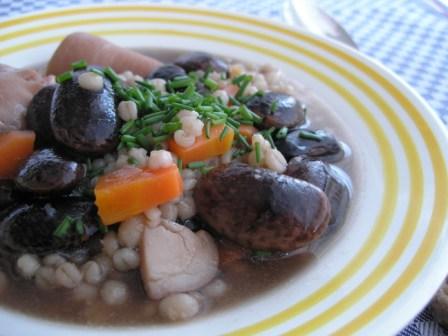
Bean soup

1-2 pig´s trotters, smoked or fresh ribs or a pig’s tail
300g beans, soaked overnight, drained
1 whole carrot
1 onion, halved
Parsley
3 bay leaves
10 black pepper corns
150g barley, soaked and drained
1 carrot cut in small cubes
1-2 teaspoons salt
Pig´s tail and trotters

Rinse the meat pieces and place them into a big cooking pot with cold water. Heat up and remove the scum. Change the water after removing the scum and add the bay leaves, pepper corns, onion, one full carrot and parsley stems without the leaves. Bring to boil and simmer for 1.5 hours until the meat is soft. Remove the parsley, onion, carrot and pepper corns from the broth. Add the beans and the barley and simmer for 1 hour or until soft. Cut the other carrot into small cubes and when beans are almost soft, add the carrot to the soup.
Either cut the meat from the bones and place back into the soup or for more fun leave them in the soup for the eaters to manage the bones and the meat.
Garnish with chopped parsley or chives.
Bean and barley soup, traditional in Estonia

This soup supports the philosophy of if you kill, eat all from head to tail.

Sunday, February 5, 2012

Farmers´ Market in winter, a very cold one too: Warm up with Salsify Cream Soup

Rustic luxury: black roots of salsify (German: Schwarzwurzel)
My walk-around last Saturday at the farmers market was brightened by long awaited snow or rather small flakes in the air that turned into wet drops on the street.  I was happy to see the winter finally arrive to the city. This week the cold from Siberia reached Switzerland and temperatures dived to the freezing -10°C in town and over -20°C in the mountains. Only a third of the usual stands were out trading in this cold, all wrapped into temporary plastic “walls”. Luckily for me snow has stayed in town and I am fully enjoying this until it lasts. You see, I am the exception to the general rule here and don’t go skiing or snowboarding in the mountains. In the Alps there is plenty of snow of course and much colder too, but for me winter is not winter if there is no snow or minimum a week of minus temperatures down in town.
Even though I like winter I don’t envy my friends in Estonia who are fighting -30s °Celsius this week. The cars won’t start, those living in houses with own wood heating have to heat and heat to keep the temperature at 13°C !!! Hang in there!!

My basic tips on how not to freeze completely in -30°C:
-wear a hat, gloves (sometimes two pairs) and plenty of layers
-wear lamb wool, cotton jumper is not warm
-breathe through the nose, occasionally rub your nose and cheeks
-go out only if really necessary and then walk fast
-when back inside and not really feeling your toes and fingers, warm up your fingers by keeping your hands under your arms, take off the socks and warm your feet against a family member’s warm body. Putting your feet against the heating will be painful! Luke warm water is another alternative to get life back in the limbs.

Soup will warm up the inside with added benefits. Cooking it will heat up the kitchen, you could use up some simple ingredients from the fridge (an onion or some bacon, a can of tomatoes), the freezer (peas maybe?) and the cupboard (lentils, a bay leaf), it has less calories and is easier to digest given the circumstances of being forced to inside activities and spending less calories.

Back to the winter market…
…Dreaming of a hot bowl of soup I was on the look-out for salsify, also known as winter asparagus or poor man’s asparagus because of the taste and their similar diuretic effects. In German it is called Scwarzwurzel and its name in Estonian is a similar translation meaning black root or mustjuur. In English it is to my surprise and puzzlement also known as oyster plant or vegetable oyster. Hmm, why do the German speakers associate salsify with asparagus and the English speaking world finds it similar to oysters? I taste rather asparagus than oysters. Not sure if it has anything to do with the fact that I live in Switzerland where oysters are rare to form strong taste memories about. Still one commonality exists, both cultures compare this from outside not quite appetising root to something rather luxurious.

You won’t find salsify in a supermarket in the Swiss capital...yet. It is a niche vegetable, quite popular amongst the fans of country food or occasionally on offer in top restaurants.

Keep raw salsify in vinegar water

How to easily peel salsify
Peeling the raw roots with a knife is tiresome and the peeled vegetables must be immediately put in water with some vinegar or lemon juice to avoid the browning. An easy way to peel the black root is to wash off the soil and cook it in boiling salt water for 10-15 minutes. Now it is as easy to peel as a cooked carrot or potato. Pull off the peel and cut out the eyes with a small  knife.

Cream of Salsify Recipe

500g salsify
0.5l chicken broth or water + 1 cube of bouillon
Bay leaf
10 cm white leek cut in 1 cm length
2 dl milk
2 tablespoons crème fraîche
2 leaves of green leek
Cooking oil
1 small chorizo picante (optional)

Bring the broth to boil, add the peeled salsify cut into smaller pieces, the bay leaf, white part of the leek and cook for 15-20 minutes till the roots are soft.
Purée with the hand mixer or blender and return into the pan. Add the milk to get the desired thickness of the soup. Stir in the crème fraîche and season to taste.

Garnish with leek julienne and spicy chorizo

Cut the leek greens into thin julienne. Heat the oil in the pan and throw in the leek. Sizzle the leeks for a few minutes until crisp but not burnt and scoop out onto kitchen paper.

If you prefer a heartier meal, cook some rings of chorizo picante or some sliced bacon in a separate pan and add on top.
Salsify cream soup with crispy leek and chorizo