Sunday, January 27, 2013

Carrot and Rutabaga (swede) soup with lime

Carrot and yellow rutabaga (swede) soup with lime

I am a big fan of winter vegetables. Carrots, beetroots, celeriac, rutabaga (aka swede in Europe), potatoes, salcify, ... In European climate they store well either in the cold stores or in some countries even in the ground. For example in the UK where the climate is milder carrots can be stored in the ground over winter. In Estonia it would not be the case as the temperatures fall and stay well under zero (Celcius) and the fields are covered in snow for weeks if not months in good winters.

These days the farmers´market on the main square in the Swiss capital has been pushed to one side making room for a temporary skating rink. In very cold days some of the farmers don´t come out and in their usual places under the arches of the market streets would be a few yawning gaps. Still there is plenty of choice to fill up each basket and trolley bag with winter vegetables, a wide range of apples and pears, fresh eggs, cheeses, butter as well as fish and meat.

Behind one of the vegetable counters is a couple, perhaps in their fifties. The man, always in winter wearing a blue knitted hat that stands up like an Egiptian pyramid on his head, his ears reaching above the rim of the hat keeping the pyramid steady on both sides. He is very energetic and talks funny in a loud voice, often measuring the vegies by eye or a feel of their weight by hand. My pound of potatoes turned out to be just over 600g when I weighed them at home. The funniest part is getting the change back, some of it is "for the taxes", the coins often "for a cup of coffee" or some other treat. :-) I bet his wife is having a laugh at home like their customers are entertained on Saturday mornings.

Carrot and yellow rutabaga (swede) soup with lime
Ingredients (for 4 as a starter or 2 as a supper)

2-3 tbsp vegetable oil
1 medium shallot onion (ca 50g), sliced
3-4 garlic cloves
1 rutabaga (ca 200g), peeled and cut into cubes
250g carrots, cut into cubes 
800ml vegetable stock
1 stalk of lemongrass
2 kaffir lime leaves
1 tbsp desiccated coconut
salt, pepper
1 tbsp cream or coconut milk  
1 tbsp lime juice
1 green onion stalk, finely chopped 

Carrot, swede, onion, ginger, garlic, kaffir lime leaves, lemon grass

Heat the oil in a pan and cook the onions until glassy, add the garlic and cut vegetables. Stir and cook for about 5 minutes before adding the stock, lemongrass, kaffir lime leaves, desiccated coconut. Bring to boil and simmer for 15-20 minutes until carrots and rutabaga are soft. They both have similar cooking time.

Purée with a mixer, add the cream and season to taste with salt, pepper and lime juice.
Serve hot with green onions.

Swede and carrot soup seasoned with lime and lemongrass

You may also like these soups:
White swede (rutabaga) and celeraic soup (with fish)
Spicy sweet potato soup
Leek and potato soup with blue Stilton
Carrot soup with courgette (zucchini) and fresh salmon 

Sunday, January 13, 2013

Winter: White swede (rutabaga) and celeriac soup with or without fish

White swede (rutabaga) and celeriac soup

Almost all food magazines I leafed through today at the kiosk dedicate a section on soups as the perfect winter food. Rightly so, however I doubt if anyone would really sit outside, read a book and enjoy a bowl of soup in winter in the northern hemisphere anywhere above the 47° N latitude like a beautiful photo was suggesting in one of these magazines.

I was waiting to board a flight around 4pm in early January in Helsinki and was looking out of the airport window. This was the time just before the evening darkness fell. My view through the frame was the dark blue sky, bordering black, a tick darker wall of forest on the horizon at the edge of the tarmac, a lonely yellow lamp not reaching past the gate, no other building in sight. The pressing "kaamos" (polar night, also referred to as winter tiredness) was only interrupted by an occasional plane rolling in to its gate somewhere. It was dark.

In the north where the darkness rules many months paradoxically the start of winter on the 21st December is actually the first step to the light again. That step is noticable already in the first days of January when the day is just a few minutes longer and life takes on a more optimistic note even if just psychologically. Most of the cold is still ahead....

Time for a bowl of soup with two winter vegetables: white fleshed swede and celeriac.
Swede is known as rutabaga in North America. If you are sensitive to the slightly bitter taste of swede then in the combination with the sweet note of celeriac that bitterness is not felt at all.

White swede (rutabaga) and celeriac soup
Ingredients (2 portions)
1 celeriac
1 white swede
bay leaf
5-6 grains of allspice
2 leaves of leek
800 ml vegetable stock
2 tablespoons sour cream or crème fraîche
a small bunch of cress
salt and black or cayenne pepper

400g bream, cod or salmon, cut into 2cm cubes
2 tablespoons (rape seed) oil

White fleshed swede (rutabaga), celeriac, leek, bay leaf, allspice

Cut the celeriac and swede into small cubes and place in a pan together with a bay leaf, grains of allspice, leek and add the stock. Cook for about 10 minutes until the vegetables are soft.
Remove from heat and take out the bay leaf, allspice and leek. Using a blender or hand mixer purée into a soup. Season with salt and pepper and mix in the cream.

Briefly fry the fish

Heat the oil in a pan and fry the fish for 3-4 minutes turning sides.

Serve the soup with chopped cress and portion the fish directly at serving.
Also tastes great without the fish as a vegetarian option.

Cream of swede and celeriac with fish

Tuesday, December 25, 2012

Christmas cookies and Estonian piparkoogid


Marzipan cookies
 
In Switzerland and Germany the typical Christmas cookies are Vanille Kipferln (vanilla half moons), Zimt Sterne (cinnamon and almond stars), and many others often made with ground almonds, hazelnuts, walnuts.

This year I set out to extend the line of the cookies and pair the dark Piparkoogid with a contrasting marzipan and orange cookies.

Marzipan - orange cookies from Germany

Piparkoogid are traditional Christmas cookies in Estonia and Scandinavia. Christmas and New Year without piparkoogid just doesn´t feel right. Piparkoogid are made with lots of different spices, cinnamon, ginger, clove, cardamom, nutmeg, orange peel, black pepper. The most important part of the preparation of the dough is burning the sugar. It gets very very hot, must not be over burnt, but under burning leaves the cookies too pale. The burnt sugar gives the piparkoogid the brown colour. It is good to let the dough rest for at least 24 hours and it can stay in the fridge even for a month. It almost has to given the volumes that all get baked during the last weeks of December.

Estonian Piparkoogid - Christmas ginger cookies

My Mom bakes lots of them for my Dad and for all the friends of the family. I usually make half of her  portion and that amounts to roughly 1000 pieces. So you can imagine a big basket of piparkoogid at my parents that gets filled and emptied and filled again. I must add that we love the very small ones and because they are small the hand just doesn´t stop going back to the bowl for more...and more...

Making Estonian Piparkoogid from dough
Small Piparkoogid are the best
I hope Santa will be in my town on the 24th, any day really would be good. He is a busy man visiting all of your towns too and hopefully with some foodie presents in his sack.

Merry Christmas to everyone!

Sunday, December 9, 2012

Pear and Persimmon Polenta Bread

Polenta Bread with Persimmon Kaki and Pear

I am lucky to have a lot of very international colleagues. My colleague who comes from Florida, a highly skilled cook herself, has awakened my palet to corn bread. This introduction happened last year during our cookbook project. To be perfectly honest I had mixed feelings with the first bite of her corn bread. On one hand I was so happy to have found something that is so simple, so tasty with qualities that would make a dish a family favourite instantly and on the other hand I couldn´t believe that it had taken me decades to get acquainted with this US staple. Of course I know why it is. Corn is not a staple in Estonia or in northern Europe for that matter. Polenta is more a southern European ingredient. It is grown in Italy or in Ticino in my current country Switzerland. In any case corn bread has found a place on my favourites list.


Today I am sharing a fruity version of the corn bread. Both pears and persimmons are quite sweet fruits and therefore don´t require too much added sugar. The changes to my friend´s recipe include adding the sour cream and the fruit, changing the quantities of flour, sugar and bicarbonate baking soda.

Pear and Persimmon Polenta Bread
Ingredients:

200g fine polenta
100g flour
1tsp bicarbonate soda
300dl butter milk
100g sour cream
2 large eggs
4 tbsp sugar
0.5 tsp salt
50g butter, melted
1 medium large pear (250g), grated
1 persimmon kaki, grated

Set the oven on 200 degrees Celsius.
In a large bowl whisk together butter milk, sour cream, eggs, sugar, salt and bicarbonate soda.
Add grated pear and persimmon, melted butter as well as the flour and polenta.
Combine everything into a smooth batter.

Fit baking paper into a tray (eg. 20 x 30cm) and trasfer the batter into the baking tray.

Bake for 30 minutes until golden brown.

Serve warm or cold. Dust powdered sugar on top if you prefer.

Fruity Corn Bread with Pear and Persimmon

Sunday, November 25, 2012

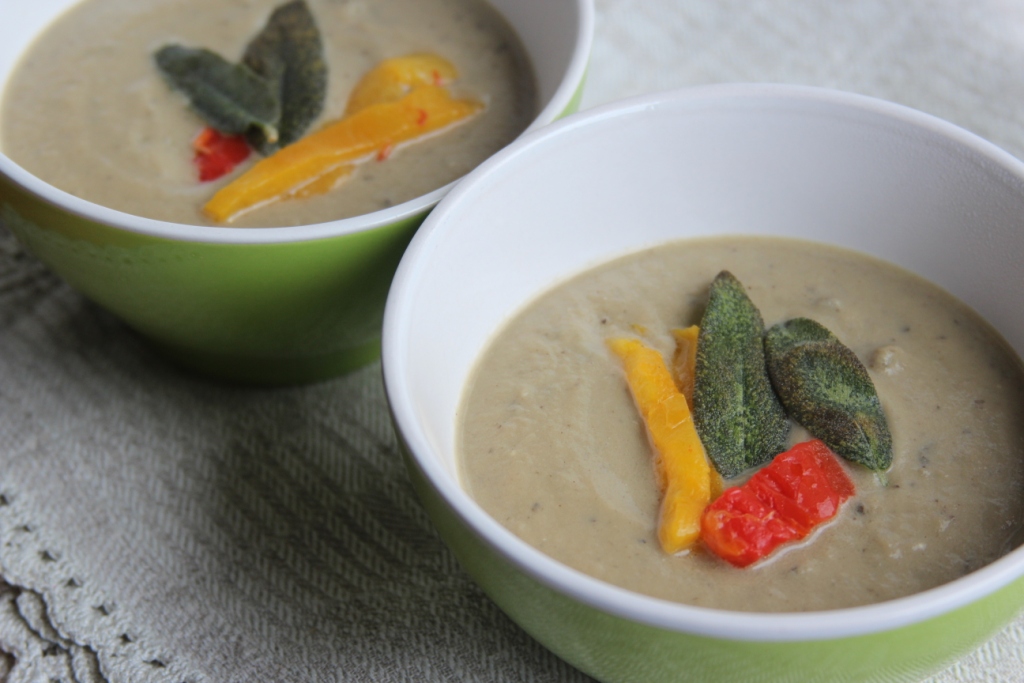
Grilled Aubergine Soup with Garlic and Sage and a glimpse at "The Pedant in the Kitchen"

Julian Barnes, a talented English writer, shares in a delightful humorous style the Pedant´s successes, frightening moments, discoveries, confusion and moments of happiness in "The Pedant in the Kitchen". This lovely book of 136 pages including illustrations takes anyone who wants to peek into other people´s kitchen to perfect dinner parties, to witness the inventory audit of the Pedant´s bottom drawer of questionable utensils, to picture the French roads with warning signes declaring "Betteraves" (beetroot), to signing up for a shopping course and handling a surly butcher or a teasing fishmonger.

I sympathise with the author as I have found myself in situations when following a recipe my cooking creation did not turn out as I had hoped or being utterly puzzled reading a recipe where the main ingredient promised in the name of the dish was not not even mentioned on the ingredient list. How much is a dash of sherry or a little sugar, how big is a medium size onion or a handful of rice? The only advice I have and follow myself is to improvise. Oscard Wilde said that cooking is an art. The Pedant in Barnes´book says that cooking is about making do with what you´ve got in ingredients, equipment and skills.

Grilled aubergine soup with garlic and crispy sage

Grilled aubergine soup with garlic and sage
Ingredients for 2-3
2 medium aubergines (400-500g)
olive oil
6 cloves of garlic
a dash of sherry (ca 0.5dl)
1 l stock
0.5-1dl fresh cream or creme fraiche
salt&pepper
6-8 fresh sage leaves
grilled paprika, yellow and red (optional)

Set the oven to 220 degrees Celsius at grill regime.

Rinse the egg plants and cut into 5-7mm slices. Place them side by side on a baking tray on a baking paper. Sprinkle with some olive oil. Grill for 15 minutes until the slices have softened.

In a pan heat 3-4 tablespoons of olive oil and add cleaned garlic cloves. Cook for a few minutes on medium heat until the garlic softens but does not burn.

Take the aubergine slices from the oven, cut into smaller pieces and add to the pot. Stir in the oil and add a dash of sherry. Let it sizzle away. Then add the stock and cook for about 10 minutes until the aubergine is soft. Take off the heat and purée with the mixer or blender.

Finish the soup with cream and salt - pepper to your taste.

In a small pan heat some olive oil (enough to cover the bottom of the pan) and fry the fresh sage leaves briefly - no more than a minute - from both sides until they become crispy. Drain on a kitchen paper.

Grilled paprika adds colour and texture to the egg plant soup

To make the grilled paprika, place whole peppers on the baking tray together with the aubergines and grill until the skin turns dark brown turning from side to side. Remove the peppers from the oven into a bowl and cover the hot peppers with a plastic bag for a few minutes. This will loosen the skin. Peel and cut into suitable slices. Store the grilled paprika in a jar with olive oil.

Serve the soup with slices of grilled paprika and the crisp sage leaves.

More soup recipes:
Spicy sweet potato soup
Leek and potato soup with blue Stilton
Salcify cream soup

Sunday, November 4, 2012

Simple "Aachener Printen" cookies, this time with figs and without anis

Aachener Printen, Christmas cookies, an old German tradition

The pre-Christmas hustle is taking up speed and density while the speed of moving around and the speed of service is going down. The streets are full of shoppers, shops are full of Christmas goods, products, decorations and gifts. The shoppers are carrying their coats under their arms or in the shopping carts to prolong or rather enable to balance the temper and temperature while the choosing of the things to buy and the wait at the check-out. No Christmas carols yet.

Last year I baked over a thousand Christmas cookies. This year could be more or a lot less since I am spending my weekend time on studying for an exam in December. I promised myself that I must manage at least some. Home made cookies are a part of the December celebration.

I was looking to widen my repertoir with some new cookies and happened on Lebkuchen which are normally thick soft cookies with a strong anis taste and smell. That´s how the Lebkuchen stand at the market outside the office smells. Most of the times I don´t enjoy anis. I am pretty sure everyone has some ingredient that they prefer to leave out of their diet. Anis is one of mine.

That little detail wasn´t going to stop my experiment with Lebkuchen. Aachener Printen is a type of Lebkuchen that gets an image "printed" on the cookie. My version is not that sophisticated, setting more worth to the inside than outside. :-) I took another liberty to change the standard recipe by adding butter. The original way of making the Aachener Printen is without fat. The recipe has been modified from one in the magazine of "essen und trinken" (I added figs, butter, changed the amount of flour, baking soda, left out pottasche, hirschhornsalz, kandis sugar). I am aware that my adjustments may be against the old traditions, but hey, all cooking is a big experiment.

Simple Aachener Printen, getting the name from the Aachen town in Germany

Aachener Printen with figs and without anis
Ingredients:
250g honey
50g sugar
0.5 dl water
80g butter
a pinch of salt
1.5 tsp cinnamon
1 tsp ground allspice
1 tsp ground kardamom
1 tsp ground cloves
1 egg, beaten
450g flour
1.5 tsp sodium bicarbonate (baking soda)
2-3 large dried figs, finely chopped 
1 tbsp starch

In a pot bring the honey, sugar and water to boil. Remove from the heat. Add the butter and let cool. Mix in the spices, salt and the egg. Combine the baking soda with the flour separately and the chopped figs with starch. Then mix the figs with the flour and add to the rest. Combine with a spatula and leave to rest for a few hours in the fridge. The dough should be quite firm, add some flour if it feels too soft. (You should be able to form a ball of the dough without it sticking to hands.)

Set the oven to 200 degrees Celsius. Spread flour on the working surface to avoid sticking. Roll the dough to a 0.5cm thickness and cut strips of ca 2cm width. Cut lengthwise into the length you like. Place on the baking tray fitted with baking paper. Bake for ca 10 minutes. Keep an eye on the oven not to burn the cookies.

Aachener Printen with figs and without anis

Sunday, October 28, 2012

Fighting the cold with soup and Spice: Spicy Sweet Potato Soup

The first snow this year

The weather forecast projected a rough drop in temperatures. The synoptics were right. The constant rain turned into snow last night and the trees are now bearing the heavy weight of 24 hours of snowfall. The lamp posts are wearing white chefs´ hats. I am not complaining at all. It is rare to have snow in town here, therefore I am happy for every moment when I see the snow falling.

The snow kept falling and falling...

This snow really came unexpected and like the cars I was still wearing "summer tyres" yesterday. Fortunately it only took me a few minutes to find my winter wear. What annoys me is if I am not dressed properly and feel the cold drilling its way into the bones.
In this situation the best is to rush to the grocery store, buy a chicken, some veggies and put the pot on to make chicken soup. Already the ancient Greeks considered that food was medicine and medicine was food.

Kaffir lime, I wish the photo could project the aroma

As a quick profylactic - while the chicken was simmering - I reached for ginger, chilli and lime (the green one). The cold is guaranteed to be replaced by a flame in the stomach and blush on the cheeks. If you can get hold of a kaffir lime, try this. Kaffir limes, like kaffir lime leaves, have a very specific aroma and taste.

Sweet potatoes
Spicy Sweet Potato Soup
Ingredients for 2:

2 tbsp cooking oil (eg. rape seed)
1 medium-small onion, chopped
2 sweet potatoes, cut into 1cm cubes
1 carrot, cut into 1cm cubes
(0.5dl white wine, optional)
1 tsp of freshly grated ginger
0.5 kaffir lime (or 0.5 standard green lime and a kaffir lime leaf)
1 chilli pod or spicy peperoncino
0.5 l stock or water
1dl fresh cream (eg. 15% fat content)
salt to taste
fresh parsley or coriander, finely chopped


Cooked sweet potatoes and spices

Heat the oil in a pan and fry the onions for a few minutes, then add the sweet potatoes and the carrot cubes. Cook at medium heat for ca 5 minutes, stirring every now and then. If you have some white wine at hand splash ca 5dl and let it evaporate. Then add the grated ginger, juice of the kaffir lime, the chilli or peperoncino pod as well as the "empty" lime peel and the stock or water. Cook at medium heat for 15-20 minutes until the vegetables are soft.

Puree with the hand mixer, at low heat mix in the fresh cream and taste. Add salt if necessary.
Serve with chopped parsley or coriander.

Spicy sweet potato soup

Sunday, October 21, 2012

Food waste statistics: reduce bread waste with Bread Pudding


Every year the 16th October is World Food Day.

In January 2012 shocking statistics were published by European Union about the millions of truck loads of food wasted every year. Foodwaste.ch statistics about Switzerland say that 2 million tons of food go to waste every year in Switzerland, a third of all food produced.

Statisctics about US: 33 million tons wasted in 2009. New York Yimes article  That Crooked Carrot is Also Food pointed out that the solution to cure the world hunger should be through reducing waste not (just) increasing agricultural yields per hectar.

In the UK 15 million tons are wasted every year according to Love food hate waste
The biggest loss happens in housholds and end consumer level - about 50% of all food waste.

Occasionally I have more bread at home than I can eat while it is still fresh. This is a sign that soon I will be eating my long time favourite bread pudding. I store the rests of old or surplus bread in the fridge to keep it from moulding.

Bread pudding with plum jam

Bread Pudding
I use this super easy recipe when I have a good handful of hard bread accumulated in my fridge.
It is difficult to give exact amounts of ingredients. The amounts depend on how much old bread you have.

Ingredients:
old bread (300g)
jam, any kind (150g)
egg(s) (2 whole eggs)
milk (1-2dl)
sugar (1 tbsp)
butter, optional (20g)

The basic instructions are:
Set the oven to 200 degrees Celsius.
Cut the old bread into ca. 1.5-2cm cubes
Choose a baking dish to allow 2 layers of the bread cubes. If you have a lot of bread you can layer as many as fits in the form. 
Cover the bottom of the baking dish with one layer of bread cubes.
Spread jam on the bread cubes to more or less cover the bottom layer. It is impossible to cover exactly all cubes and this is not necessary. Depending on the consistency of the jam just dollop a few tablespoons of jam and spread it around a bit. It does not have to be perfect.
Arrange the rest of the cubes into the baking form. If you like a sweeter dish, fill some empty spaces between the cubes with more jam.
Whisk the egg(s) with a fork to combine the egg white and yolk, add the sugar and milk, mix and melt the sugar. Pour the egg-milk mixture on the bread cubes and lightly press the bread to absorb the liquid. The bottom layer should be covered with the liquid.
For extra touch of luxury place 3-4 small knobs (2 cm) of butter on top of everything.

Bake in the oven for 20-30 minutes until the bread on the top turns crisp and slightly browned.

We used to eat this dessert with milk. I would place a portion of the bread pudding into a bowl and pour milk over it and eat. I still eat it with milk when the pudding has turned cold. It is totally OK to eat it warm. Anyway I can´t wait until it turns cold and I enjoy the crusty cubes from the top layer and the soft jammy ones from the bottom straight hot from the oven. Pairs well with a cup of coffee too.

Bread and Jam Pudding

Thursday, October 18, 2012

Who or what are toast soldiers?

English breakfast table, nice silverware, a cup of tea and toast soldiers

The modern technology makes it so easy to participate live in a feast with friends in another country or with a few minutes delay we see an exact snapshot of what´s on the plate of our foodie friends 1000km away.

This morning I had a "virtual" traditional breakfast in Durrants Hotel, in a 18th century building in central London. Old school. The toast was presented in the classic English way as toast "soldiers" for dipping in the soft boiled egg (4 to 5 minutes cooking).

My dear colleague and friend Mark who invited me to this breakfast said that as children they were encouraged to eat boiled eggs with toast soldiers - strips cut to fit an egg. They are sort of at attention like a guardsman.

Although children tend to eat like this - it is sweet to see that grown men are still served their toast soldiers, they never grow up! And that is brilliant!


Sunday, October 14, 2012

Leek and potato soup with blue Stilton

Stilton is a town in Cambridgeshire in England. It is said that the travellers who were staying at the Bell Inn in Stilton made good word-to-mouth advertising to the cheese they were served at the inn on the Great Northern Road. But the Stilton is not from Stilton even though Stilton may have given the name to the famous Stilton.  It is said that in the early 18th century the owner of the Bell Inn "imported" it from a cheesemaker´s in a village in Leicestershire. Stilton cheese has the Protected Designation of Origin seal and it may only be produced in Leicestershire, Derbyshire and Nottinghamshire and only local milk may be used.

Blue Stilton cheese

Blue Stilton is best made out of the summer milk, mature for 12 weeks and is said to reach the culinary climax in November. Blue Stilton is sometimes served with port. Cooking this soup with port instead of white wine gives the soup the sweet slightly noticeable taste of the port.

Blue Stilton sold in a lovely little container

Leek and Potato Soup with Blue Stilton

Ingredients for 2

2 tbsp rape seed oil
200g leek, the white part, halved and chopped
2 medium potatoes, cut in small cubes
0.5dl white portwine
0.7 l vegetable or chicken stock
0.5dl fresh cream
30g blue Stilton cheese

Leek and potato soup with blue Stilton


Heat the oil, add the leeks and cook until the leek turns soft. Splash in the white port wine and cook until the wine has almost evaporated. Then add the potatoes and stock and cook until the potatoes are soft. Puree with the handmixer. Add the cream. Taste for salt. Take off the heat and serve with crumbles of blue Stilton on top. The cheese will melt rather quickly and give the soup its final taste.

Blue Stilton cheese and port lift up the leek


Saturday, October 6, 2012

Beetroot cinnamon rolls

The 4th of October is the national cinnamon roll day or "Kanelbullens Dag" in Sweden. I am a great fan of cinnamon rolls and all kinds of baking creations made with cinnamon. The Cinnamon Roll Day is celebrated every year at the Swedish Embassy in Tallinn, the capital of Estonia. Surely this builds great relations between the two countries.

I believe that all Estonians who have read Astrid Lindgren´s Karlsson stories remember how he wrote on the wall to the housekeeper Hildur Bock or Husbocken (Est. Majasokk, English translation Housegoat) "There should be more cinnamon in your damn expensive rolls " (Sinu neetult kallites saiades peaks olema rohkem kaneeli)! Quite right! I have never eaten a cinnamon roll with too much cinnamon in it.

The cinnamon rolls are very popular in the Northern countries of Europe, Estonia included. The memory of the warm buttery cinnamon rolls coming out of the oven is one that stays in the mind for ever and just a thought about these rolls makes people smile. It is difficult, I would say impossible, to eat just one of the freshly baked rolls.

Cinnamon rolls, a favourite of millions northerners

I thought to celebrate this year´s cinnamon roll day a little differently, with pink rolls.

Beetroot cinnamon rolls

Ingredients for the dough:
300g flour
70g sugar
20g fresh yeast
1dl warm milk
1 egg
75g soft butter
a pinch of salt
a pinch of ground cardamom
1 small raw beetroot, finely grated (ca 100-120g)

The filling:
70g soft butter
sugar
cinnamon

Mix the yeast with warm milk. Place the flour and sugar in a large mixing bowl. Add the warm milk with yeast, the egg, soft butter, a pinch of salt and the other of cardamom. Add the grated beetroot. Mix the ingredients together until a homogeneous dough is formed.

Cover the bowl with a teatowel and keep it in a warm place (avoid draft!) for about an hour or until the dough has doubled in volume.

Be generous with the filling

Spread some flour on the working table and place the dough in the flour. Roll the dough so that it is covered loosely with flour to avoid sticking to the table. Spread the dough or use the rolling pin to form just about 1cm thick layer. Spread the soft butter more or less evenly on the dough, sprinkle with sugar and as much cinnamon as you like. It is better for the final outcome to be generous with the filling.

An way of non-sticky baking

Pre-heat the oven to 190 degrees Celsius.

Leave rolls to raise a little more

Roll the dough lengthwise into a long roulade and cut ca 3cm pieces.
Please them on a baking tray covered with baking paper or use the muffin tray. I used small pieces of baking paper in the muffin tray to avoid sticking. Leave under a teatowel for 20 minutes to raise for the second time.

Bake for 20 minutes.

Cinnamon rolls with beetroot

Related posts:
Cinnamon loaf

Sunday, September 30, 2012

Carrot soup with courgette and salmon

Carrot soup with courgette (zucchini) and salmon

It finally hit my brain when I was walking around the farmers´market that the summer is gone. All signs were there: quince had appeared on some counters, the choice of tomatoes had more than halved, winter cabbages like cavalo negro and kale were on sale, at one stand I heard the saleswoman explain to a puzzled customer that "the season for basil is over"....How did it happen that the basil season totally passed this year before I had stocked up with fresh pesto? Oh well, the supermarket sells basil all year round and that will get me through winter ...probably at the cost of a higher carbon footprint.

Quince, an autumn and winter fruit

The shoppers were trying to fit under the roofs of the stands with their umbrellas and apologising to the other dripping customers. It was pouring for hours and the amount of daylight stayed below 5 on a scale of 10 the whole day.  I was looking forward to a lazy afternoon in front of the telly and the 5-DVD set of a Danish thriller I borrowed from my friend last weekend.

Kale, only available in autumn and winter at the market

At that dismal, sort of Wagnerian Melancholia market I was thinking Soup! Something bright and orange. I had bought 2 kilos of bio carrots at a good deal earlier in the week. Perfect starting point for my new favourite soup of this autumn. A bowl of carrot soup with courgette and salmon is a low fat but belly filling option for lunch or supper for the days when you just wish for a soup that you can bite into. I am a great fan of smooth cream soups, but equally on other days the soup just needs to be a bit more solid.

And a little fat must be. I am glad that fat helps me to get the vitamin A out of the carrots into my body but more importantly the small golden shiny bubbles that glisten on the surface act like a promise of a great meal and produce zillion of happy hormones before I have even taken a bite. The soup is ready in about half an hour. I can manage that after a long working day and still have a freshly made great tasing meal.


Carrot Soup with courgette (zucchini) and salmon
Ingredients for 2

500g carrots, cut into cubes
0.5l stock (or water + 1 cube bouillon)
1 whole yellow peperoncini or a chilli pod
0.5 tsp fresh ginger, grated
1 medium courgette, cut into cubes
250g fresh salmon, cut in 2 cm cubes
2-3 tbsp fresh cream

Bring the water to boil, add the bouillon, carrots, peperoncini and grated ginger. Cook on medium heat until the carrots are soft. Take a few table spoons of carrots out and put aside for later. Remove the peperoncini. Purée the carrots. Taste for salt and spice. Add the courgette cubes and cook for a couple of minutes. Then add the salmon and cream. Continue cooking on low -medium heat for a few minutes. Be careful not to cook too long as the salmon will become chewy and courgette too soft.

If you don´t have fresh fish, try frozen white fish filet. Cut into cubes and add to the carrot purée before the courgette but still be caucious not to over cook the fish. Adding the frozen fish would cool down the soup, so bringing it to boil and then adding the courgette for a few minutes more on the heat would be about right.

Carrot-courgette & fresh salmon soup

Related posts:
Caldo Verde, an autumn soup
Buying carrots

Saturday, September 22, 2012

Manor Food Store in Geneva

Sourdough bread with raisins from Manor Food department store, Geneva

People develop favourites among restaurants they want to visit again and again, even go as far as taking a flight to another country to repeat a memorable eating experience. Likewise there are some food stores that appeal more than the others. For me one of those is at Manor department store in Geneva. That is the shop that I always try to visit, even if I am short of time. I wonder if it actually is the store with the widest choice in Switzerland.

Most food shopping in Swiss cities is done in two big retailers Coop and Migros. Many of my friends say that they have to shop at both as some things are not sold or are better in one, others better in the other store.

There is also Globus department store with a food floor that is upmarket and holds a range of more gourmet taste ingredients. David Lebovitz has described the Globus experience well.

I crave to wonder around the Manor Food store. It is like a drug, just a walk around has a healing and stimulating effect to the food side of my brain.

Their fresh bread assortment is rich with sourdough breads, rolls, baguettes, loaves of all sorts. Every time I visit I MUST buy the pain au levain with raisins. The freshly baked warm loaf is close to a meter long and weighs several kilos. You can show how long a piece you would like and they cut your "loaf" for you. Similar sourdough breads, all freshly baked, are also available with figs or apricots.
Pain au levain aux raisins

There was fresh octopus carpaccio sliced and packed in appetizer size portions. I´ve not seen that sold anywhere else in Switzerland. The fresh meat offering ranged from numerous sorts of birds in different cuts or whole birds, ribs that seemed to have enough meat on the bone for juicy rib roast or BBQ. People who enjoy liver and other inner organs would find at Manor whatever the recipe requires. Even brain, I saw.

For the sushi lovers there is now an even bigger counter for sushi, freshly made at the store. Dim sum and other Asian bites can be bought there too.

All foodies, Manor Food and department store is five minutes from Central Station at:
Rue Cornavin 6
1201 Genève

Related posts:
Sourdough bread, a beginners experiment 

Wednesday, September 12, 2012

Food from the forest 3: Wild Mushroom Picking in Estonia - Mushroom Schnitzel

Pine forest in South Estonia

Back in the forest! Every autumn (and late summer) there are people in Estonia waiting impatiently for the peak season. The feeling is totally comparable to the feeling that people in Switzerland experience for the ski season.  The weather conditions are being discussed at length, the prospect of the season, any issues and successes shared with friends and family.

The national sport of picking wild mushrooms is part of the culinary year that culminates in September. The mushroom season gets a fair portion of media coverage in the newspapers and national TV through interviews with mushroom experts, commentary from the national forestry office, numerous new mushroom recipes get published, even the weather man in the morning wake up program started his weather talk about how he spent the weekend picking mushrooms and showed a couple of proof photos. Lots of fun and a topic that always guarantees a good feeling, even in a poor crop year that leaves you with a story about how someone walked around for hours and came home with 3 mushrooms to tell in the following year , khmm, I mean years...

2012 is a year of plenty in volume and in diversity of different kinds of mushrooms.

Rosites caperata (Lat.), Kitsemamplid (Est.)

Young Kitsemampel
 
One of them is called "Kitsemampel" in Estonian, its Latin name is Rosites caperata. The name is made of two parts: the first - kitse - means a goat's, the second - mampel - is a type of mushroom, (my current knowledge does not know how to translate this). Perhaps goats liked this type of mushrooms too.
Some mushrooms can be eaten simply sautéed like chanterelles or champignons or kitsemampels, others require pre-cooking in boiling water. Kitsemampel suits well for "schnitzel" or escalope.

Large Kitsemampel is good for schnitzel

Mushroom schnitzel
Ingredients for 2-3 portions

8 Bigger size flat shape mushrooms, Kitsemampel is a classic for this dish
1 large egg
0.5-1dl milk
0.5 cup plain flour
salt
pepper
frying oil (eg rape seed)

Lightly beat the egg with milk.
Clean the mushrooms from debris and sprinkle with salt and pepper and leave for ca 20 minutes. This brings out some liquid and that is useful to stick the flour to the surface. So, pat the mushrooms in the flour on a plate and then dip them through the egg mixture.

Heat the oil in a frying pan and place the mushrooms on the pan. Fry on medium heat until the mushrooms soften and the "schnitzel" takes on a nice golden colour, ca. 10-15 minutes. The frying time depends on the size of the mushrooms.

Serve with fresh tomatoes, cucumbers, lettuce, with sauteed potatoes or other vegetables or as a burger in a fresh bun.

Schnitzel from Kitsemampel mushrooms

More stories on Food from the Forest:
Estonian mushroom salad, spinach & chanterelle soup, Estonian mushroom burgers
Wild blueberry & ricotta cake, wild blueberry & banana smoothie
Wild blueberry soup with fluffy semolina dessert
Estonian cranberry dessert - pink semolina